Eat to Fuel, Not to Shrink: How to Feed Your Body After 50
Quick Answer
Eat more on purpose, not less. After 50, muscle needs a bigger dose of protein at each meal before it responds: about 25 to 30 grams, three times a day, for a daily total near 0.7 to 0.8 grams per pound of body weight. Build each plate around that protein, add plants, and stop asking dinner to carry the whole day.
What if your body isn't the problem?
What if the way you've been feeding it has been working against you this whole time?
I see it every single day. Women in midlife who are eating less, restricting more, cutting out food groups... and feeling worse for it. More fatigue. More frustration. A waistline that doesn't care how good they've been.
After 50, your body doesn't need less food. It needs different food. More protein, more plants, and a completely different relationship with what goes on your plate.
Why does eating less stop working after 50?
Most of us are still running a plan handed to us in our 20s. Low calorie. Low fat. Cardio to burn it off.
Here's the quiet problem with that plan in midlife. When you eat less, you almost always eat less protein, and protein is the one thing a changing body can least afford to lose. Muscle is what keeps your metabolism, your blood sugar and your balance on your side.
And an older muscle is a little harder of hearing. In a pooled analysis from Stuart Phillips's lab, older men needed about 0.40 grams of protein per kilogram of body weight in a single meal to switch muscle building fully on, compared with about 0.24 for young men. For a 150-pound woman, that works out to roughly 27 grams.
Honest framing: that analysis was in men, measured in a lab over a few hours, and looked back across earlier studies. It points the direction. It doesn't hand you an exact number for your own body.
That's the science behind the number I teach. Not more food for the sake of it. Enough protein, at each meal, to be heard.
How much protein do I need at each meal?
25 to 30 grams, three times a day. Across the day, that lands near 0.7 to 0.8 grams per pound of body weight. For a 150-pound woman, about 105 to 120 grams.
The spread matters as much as the total. Most of us eat a light breakfast, a medium lunch, and then load up at dinner. A 2014 study in the Journal of Nutrition tested exactly that. Eight adults ate the same total protein two ways for a week each: about 30 grams at every meal, or 10 at breakfast, 16 at lunch and 63 at dinner. Muscle protein synthesis over 24 hours was 25 percent higher on the even plan.
Honest framing: eight people with an average age of 37, one week per plan. Small, careful, and not the final word.
You don't need to eat less. You need to eat with intention. Protein first. Whole foods. Meals that fuel your metabolism instead of fighting it.
What does a fueled day actually look like?
Here's what I teach every woman in my programs. Half the plate is vegetables. A quarter is protein. A quarter is slow carbs or healthy fats. Simple. Sustainable. No math required once you've done it a few times.
- Breakfast, about 29 grams. One cup of plain Greek yogurt (about 23 grams) with berries and two tablespoons of hemp seeds (about 6 grams).
- Lunch, about 30 grams. A big salad or grain bowl topped with 3.5 ounces of cooked chicken breast.
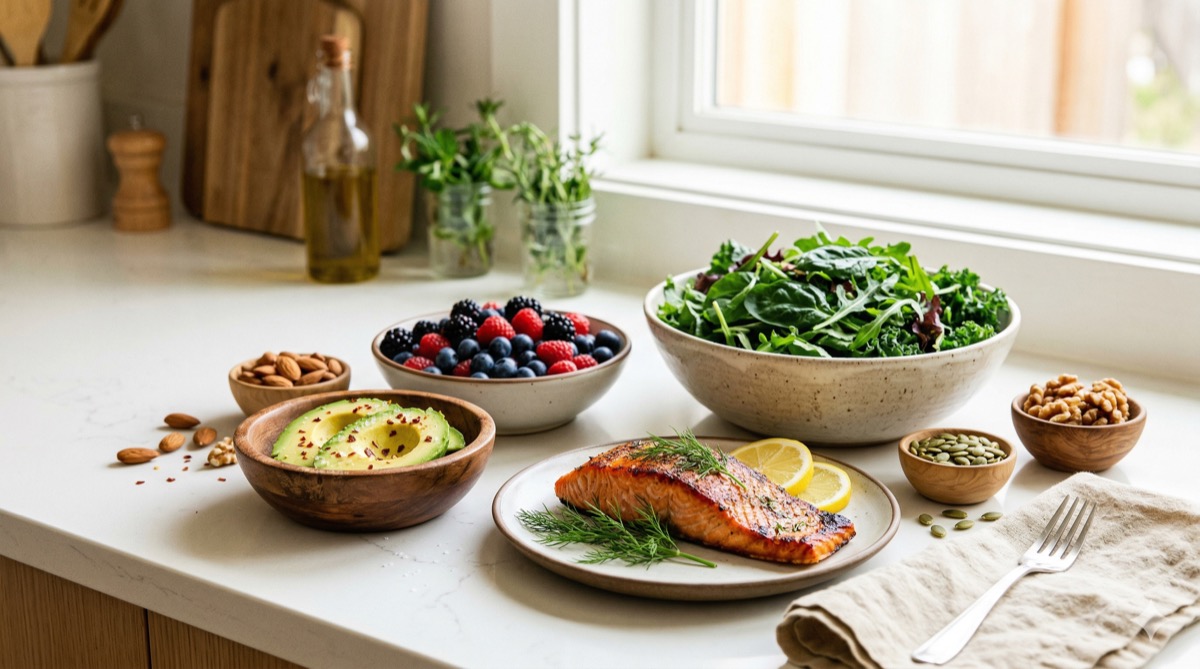
- Dinner, about 26 grams. Four ounces of cooked salmon, roasted vegetables, and a scoop of potatoes or rice if you want them.
- One snack to round it out. A half cup of cottage cheese or a protein shake brings the day to roughly 100 to 115 grams.
Not hungry in the morning? You don't have to eat the minute you wake up. Make the first meal of your day the one that counts, because breakfast is where most women come up shortest.
How I teach women to eat for fuel
I teach my clients to eat after 50 for fuel, and it starts with protein. Thirty grams at breakfast is the starting point. Then we aim for 30 to 35 grams at lunch and at dinner. Next we add fiber to every meal. Once those feel natural, we add a probiotic food, like yogurt or sauerkraut. They all work together.
Michelle, from my first cohort, is a great example. Once she started her early mornings with protein, she lost 20 pounds in her first 10 weeks.
Twenty-five to 30 grams per meal is the floor that switches muscle repair on. Many of my clients aim a little higher at lunch and dinner.
What if I've been undereating for years?
Start with one meal, not all three. Most women I work with begin with breakfast, because it's usually the lowest-protein meal of the day and the easiest one to change.
Give it two weeks before you judge it. Notice your energy at 3pm, your cravings after dinner, and how your workouts feel. Those tend to move before the scale does.
If you have kidney disease or your doctor has asked you to limit protein, talk with them before you raise your intake.
Three things to hold
- Feed, don't shrink. Eating less usually means eating less protein, and midlife muscle can't afford it.
- Count to 25 to 30, three times. A steady dose at each meal beats a big dinner.
- Start with one plate. Pick the meal that's lowest in protein now and build it up first.
I am not too much and I am not too late. I feed this body for the season it's in. Today I start with one plate.
Frequently asked questions
How much protein does a woman over 50 need per meal?
About 25 to 30 grams, three times a day. That adds up to roughly 0.7 to 0.8 grams per pound of body weight, or about 105 to 120 grams for a 150-pound woman.
Is it better to eat less to lose weight after menopause?
Eating less often means eating less protein, which makes it harder to keep the muscle that supports your metabolism. In my experience, most women do better eating enough protein at every meal, lifting, and letting body composition change before the scale does.
Does it matter when I eat my protein?
The spread matters. In a small 2014 study, the same total protein eaten as about 30 grams per meal produced 25 percent more muscle protein synthesis over 24 hours than a plan that saved most of it for dinner.
If this landed
Start with protein. Start with one meal. Start today.
I see you. I've got you. You're not behind.
With love,
Kim
Want the plate framework on paper?
The free 25-Gram Protein Plate Guide gives you the plate formula, portion visuals, meal ideas and a grocery list, the same framework I use with every client.
Get the free Plate Guide →Sources
Moore DR, Churchward-Venne TA, Witard O, Breen L, Burd NA, Tipton KD, Phillips SM. Protein ingestion to stimulate myofibrillar protein synthesis requires greater relative protein intakes in healthy older versus younger men. Journals of Gerontology Series A. 2015;70(1):57-62. Retrospective pooled analysis; muscle protein synthesis plateaued at about 0.40 g/kg body mass per meal in older men (about 71 years) versus 0.24 g/kg in younger men. PubMed
Mamerow MM, Mettler JA, English KL, et al. Dietary protein distribution positively influences 24-h muscle protein synthesis in healthy adults. Journal of Nutrition. 2014;144(6):876-880. Crossover study in 8 adults (mean age 37); about 30 g protein per meal produced 25 percent higher 24-hour muscle protein synthesis than a skewed 10/16/63 g pattern. PubMed

Strength trainer since 1982, certified spiritual counselor and bestselling author of Morning Mantras That Will Change Your Life. Kim helps women in menopause and midlife build muscle and metabolism with science and soul. Founder of The Ageless Reset. More about Kim →
Want your exact daily number? Get my free Ageless Starter Kit, with a protein chart from 115 to 165 pounds.
Keep reading
- What to Eat at Dinner for Better Sleep
- Belly Fat After Menopause: Why You're Gaining Weight Even When You're Eating Less
- Know Your Protein: Collagen vs Protein Powder vs Aminos, Plus Creatine
- The Omega-3 Truth: What Women Over 50 Need to Know
More about Kim's science and soul approach on the About page, or see every way to work with Kim.