Does Cooking at Home Help You Live Longer?
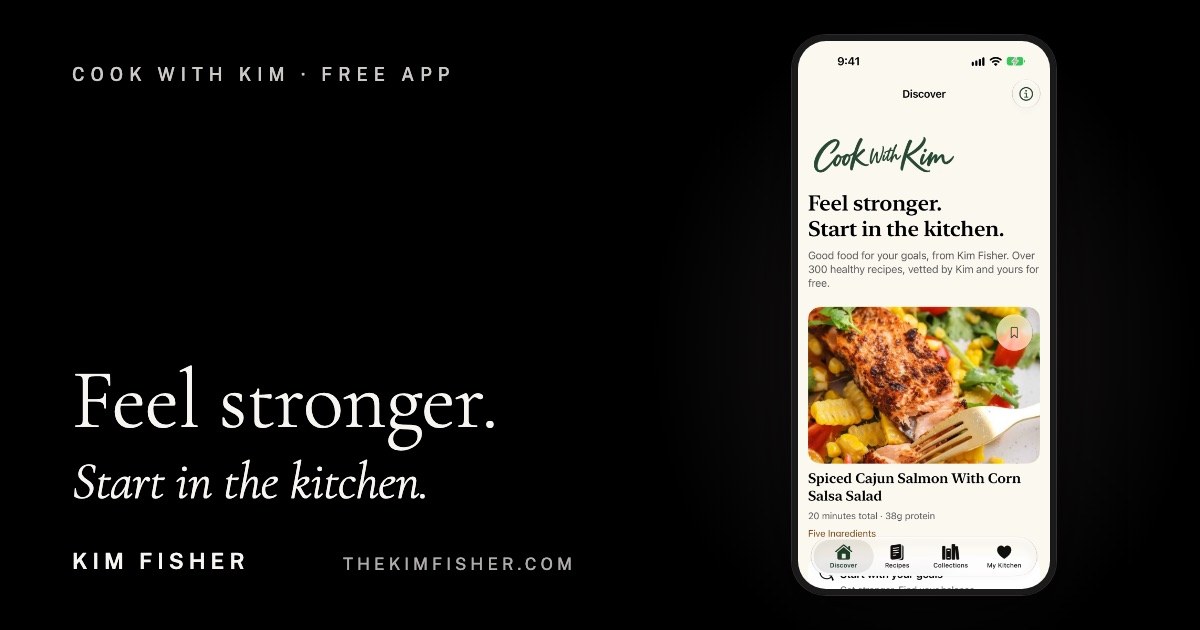
Cook With Kim, my free recipe app, November 2026.
Quick Answer
It may. In a 10-year study of 1,888 adults over 65, cooking at home more than five times a week was linked to a 41% lower risk of dying, and women benefited most. It's an observational study, so cooking is likely one part of a healthier life rather than a cure on its own.
Five meals a week at your own stove.
Ten years later, the people who cooked most were 41% less likely to have died.
The reason isn't only what was on the plate.
For eight years, my recipes lived in nine separate cookbooks you could buy on my website. High protein, smoothies, low carb, gluten free, vegetarian, plant-based, five ingredients, immunity support and holiday treats. This fall I put every one of them, more than 300 recipes, into one free app called Cook With Kim. I'm 64, and I've coached strength for 44 years. The line on the front of that app is the one I keep coming back to: feel stronger, start in the kitchen. This week the research gives that line a number. One of my favorites is the pork meatballs below. I've even made them with ground chicken instead, if you don't eat pork, and they're every bit as delicious both ways.
What a 10-year study found
Researchers in Taiwan followed 1,888 adults aged 65 and older, all living independently, for ten years (Chen and colleagues, Public Health Nutrition, 2012). At the start, they asked a simple question: how often do you cook? By the end of 2008, 695 of them had died.
The people who cooked more than five times a week were far more likely to still be alive. After the researchers accounted for physical function, memory and thinking, nutrition knowledge and other differences, frequent cooks still had a 41% lower risk of dying than people who never cooked. Women gained the most. Comparing the most cooking with the least, women's risk fell by about half, men's by about a quarter.
What changes on the plate
A second study looked at 9,569 adults in the United States (Wolfson and Bleich, Public Health Nutrition, 2015). In homes where dinner was cooked six or seven nights a week, people ate about 137 fewer calories a day, 5 fewer grams of fat and 16 fewer grams of sugar, about four teaspoons, than in homes that cooked once a week or less. That held whether or not they were trying to lose weight.
The honest fine print
Both are observational studies. They show a link, not proof that cooking itself added years or took away calories. In the Taiwan study, the frequent cooks were also more likely to walk or shop more than twice a week, eat more vegetables and less meat, and share dinner with a spouse, and some of that healthier life may be doing the work. That study was in adults over 65 in Taiwan, with follow-up ending in 2008. The second study is a one-day snapshot of what people ate, not a trial. So I say "linked to," never "guaranteed," and never "cures."
The part almost nobody mentions
Here's the surprising piece. The frequent cooks weren't only eating differently. They were walking or shopping more often, carrying the bags, standing at the stove, planning the week's meals in their heads. Cooking is a whole-body habit that looks like a chore.
Your kitchen is also the one place you control your protein. In a small study of eight adults, spreading about 30 grams of protein across breakfast, lunch and dinner raised muscle protein building over 24 hours by 25%, compared with eating most of it at dinner (Mamerow and colleagues, Journal of Nutrition, 2014). A drive-through breakfast rarely hands you 30 grams. Your own stove can.
The reframe
You don't need to become a gourmet cook. You need five nights a week at your own stove, with a plate that reaches about 30 grams of protein.
Three things to take with you
- Pick your five. Choose five nights this week you'll cook at home, and put them on your calendar before Monday gets busy. Simple counts. Eggs and greens on a Tuesday count.
- Build each plate to about 30 grams of protein, starting with breakfast, the meal most of us leave short. Every recipe in my app shows its protein per serving, with a Make it 30 tip when it falls short.
- Start with five ingredients. Fewer ingredients means fewer reasons to order in. The three recipes below are from my Five Ingredients cookbook, now free in the app.
Three recipes to start this week
All three come from my Five Ingredients cookbook. If you want more to choose from, there are plenty on my high-protein recipes page.
Classic Shakshuka (breakfast)
Serves 2 · 25 minutes · 16g protein per serving, about 31g with Make it 30
What you need: 1 white onion, sliced; 2 bell peppers, sliced; 2 cans (14 oz. or 400g each) chopped tomatoes; 4 eggs; 4 tbsp. chopped parsley leaves. Plus olive oil, salt and pepper.
How to make it:
- Heat 1 tbsp olive oil in a non-stick pan over medium-high heat. Cook the onion and bell peppers for 5 minutes until softened.
- Add the chopped tomatoes and cook for 5 more minutes.
- Make 4 wells in the mixture and crack an egg into each. Reduce the heat to low, partially cover, and cook for 10 minutes or until the egg whites are set.
- Sprinkle with the parsley, season with salt and pepper, and serve.
Make it 30: stir 1 cup cooked lentils into the sauce with the tomatoes and crack 2 extra eggs into the pan for about 15g more protein per serving, roughly 31g.
Baked Lentil & Parsley Falafels (lunch)
Serves 4 · 30 minutes · 10g protein per serving, about 31g with Make it 30
What you need: 14 oz. (400g) cooked lentils; 2 oz. (60g) fresh parsley; 2 cloves garlic; juice of 1 lemon; 2 tbsp. all-purpose flour. Plus olive oil and salt.
How to make it:
- Preheat the oven to 350°F (180°C).
- Pulse the lentils, parsley, garlic, lemon juice, 1 ½ tbsp olive oil and 1 tsp salt in a food processor until crumbly and the mixture sticks together. Stir in the flour.
- Shape a large tablespoon of the mixture into a patty and place it on a baking sheet. Repeat with the rest.
- Bake for 18 to 20 minutes.
- Serve warm or cold in salads, sandwiches or bowls, or with dips. Leftovers keep in the fridge for 2 to 3 days.
Make it 30: serve each portion with ½ cup shelled edamame and 3.5 oz. (100g) baked firm tofu for about 21g more protein, roughly 31g.
Easy Pork Meatballs in Tomato Sauce (dinner)
Serves 4 · 35 minutes · 20g protein per serving, about 29g with Make it 30
What you need: 14 oz. (400g) lean minced pork; 1 clove garlic, minced; 1 yellow onion, chopped; 16 fl. oz. (480ml) passata; 4 tbsp. chopped parsley leaves. Plus olive oil, salt and pepper.
How to make it:
- Season the pork with salt and pepper, add the garlic and mix. Shape into 1-tablespoon meatballs.
- Heat 1 tbsp olive oil in a pan over medium heat. Cook the meatballs, turning occasionally, for 10 minutes until browned and cooked through (160°F or 71°C). Set aside.
- Add another 1 tbsp oil to the same pan and cook the onion for 3 to 4 minutes until soft.
- Return the meatballs to the pan, add the passata and season. Bring to a boil, then simmer for 10 minutes.
- Serve sprinkled with the parsley.
Make it 30: serve each portion over ½ cup cooked lentils for about 9g more protein, roughly 29g.
Kim's swap: not a pork eater? Ground chicken works in place of the pork.
All 300 of my recipes, free
All three of these live inside Cook With Kim, with more than 300 others from my nine cookbooks. Each one shows its protein per serving, and you cook it one step at a time, with a timer and a checklist, so dinner feels calm instead of like one more thing to manage. It's free on iPhone and iPad. No account, no ads, nothing to buy.
I am strong, and my strength starts at my own stove. Five nights. Thirty grams. One plate at a time.
Frequently asked questions
Is cooking at home healthier than eating out?
In a study of 9,569 US adults, homes that cooked dinner six or seven nights a week ate about 137 fewer calories and 16 fewer grams of sugar a day than homes that rarely cooked, whether or not anyone was trying to lose weight. It shows a pattern rather than proof, and it points the same way as the 10-year survival study.
How often do I need to cook at home to see a benefit?
In the 10-year Taiwan study, the benefit showed up in people who cooked more than five times a week, compared with people who never cooked. Start where you are. If you cook twice a week now, add one night, then another, until five feels normal.
How much protein do I need at each meal after 50?
Aim for about 25 to 30 grams at each meal. A small 2014 study found that spreading about 30 grams across three meals raised 24-hour muscle protein building by 25% compared with saving most of it for dinner. I go deeper on this in Eat to Fuel After 50.
Is there a free recipe app for women over 50?
Yes. Cook With Kim is my free recipe app for iPhone and iPad, with more than 300 recipes from my nine cookbooks, each showing its protein per serving. No account, no ads, nothing to buy. You can get it at thekimfisher.com/cook-with-kim.
My gift to you
If you'd love a head start on those five nights, Cook With Kim is my gift to you: every recipe from my nine cookbooks, more than 300 of them, free on your iPhone or iPad. Tell me where to send it at thekimfisher.com/cook-with-kim, and your link opens right away. I've got you.
With love,
Kim
More than 300 recipes, free.
Every recipe from my nine cookbooks, now in one free app. Each one shows its protein per serving. No account, no ads, nothing to buy.
Get Cook With Kim free →Sources
Chen RC, Lee MS, Chang YH, Wahlqvist ML. Cooking frequency may enhance survival in Taiwanese elderly. Public Health Nutrition. 2012;15(7):1142-1149. pubmed.ncbi.nlm.nih.gov/22578892. Cohort study; 1,888 free-living adults aged 65 and older; 10-year follow-up; 695 deaths. Cooking more than 5 times a week against never cooking: hazard ratio 0.47 unadjusted, 0.59 after adjustment (95% CI 0.41 to 0.86), about a 41% lower risk. Women's hazard fell 51% against men's 24%, most cooking against least. Observational.
Wolfson JA, Bleich SN. Is cooking at home associated with better diet quality or weight-loss intention? Public Health Nutrition. 2015;18(8):1397-1406. pubmed.ncbi.nlm.nih.gov/25399031. NHANES 2007 to 2010; 9,569 adults; dinner cooked 6 to 7 against 0 to 1 times a week: 9,054 against 9,627 kJ a day, about 2,164 against 2,301 calories; fat 81 against 86 g; sugar 119 against 135 g. Cross-sectional, one 24-hour recall.
Mamerow MM, et al. Dietary protein distribution positively influences 24-h muscle protein synthesis in healthy adults. Journal of Nutrition. 2014;144(6):876-880. pubmed.ncbi.nlm.nih.gov/24477298. Crossover feeding study; 8 adults, mean age 37; about 30 g protein at each meal against 11, 16 and 63 g: 24-hour muscle protein synthesis 25% higher. Small, younger adults, 7 days.
Recipes: Kim Fisher, Five Ingredients, The Nourish Collection, now inside the Cook With Kim app. Servings, protein per serving and Make it 30 figures are from the cookbook.

Strength trainer since 1982, certified spiritual counselor and bestselling author of Morning Mantras That Will Change Your Life. Kim helps women in menopause and midlife build muscle and metabolism with science and soul. Founder of The Ageless Reset. More about Kim →
Keep reading
- Eat to Fuel, Not to Shrink: How to Feed Your Body After 50
- Protein and Fiber First: The Simplest Food Reset That Actually Works
- Know Your Protein
- Muscle Is Your Longevity Organ... Here's Why That Changes Everything
More about Kim's science and soul approach on the About page, or see every way to work with Kim.